
Key Points
- Central HVAC systems use a series of ductwork to spread well-conditioned air throughout the space, creating a uniform temperature in every room.
- Central split systems have both indoor and outdoor units, whereas central package units store all hardware in a single cabinet outside of the building, requiring only ductwork to be installed within the building.
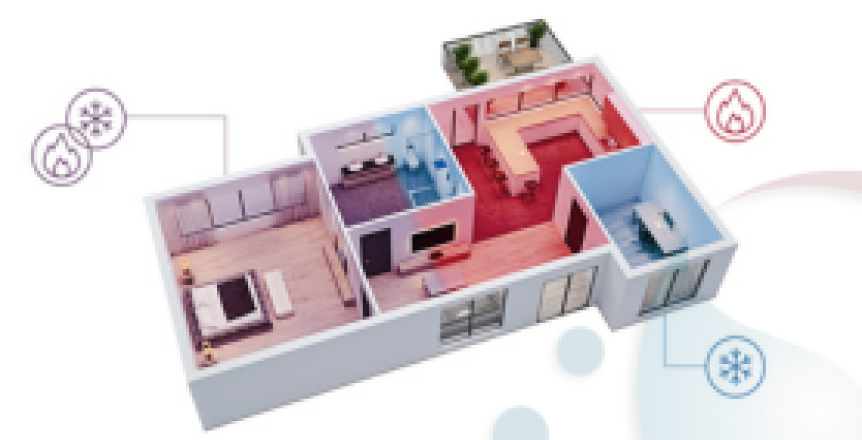
- Ductless HVAC systems do not use ductwork, meaning each zone chooses its own climate control settings without affecting other parts of the building.
- Every central heating and cooling system requires professional setup. Most ductless HVAC options also need a trained technician, but some options like IWAE’s TruInverter series and MrCool’s DIY lineup support do-it-yourself installation.
- When choosing between a central or ductless HVAC system, consider all the factors like zoning needs, square footage, installation preference, energy efficiency, budget, and maintenance needs.
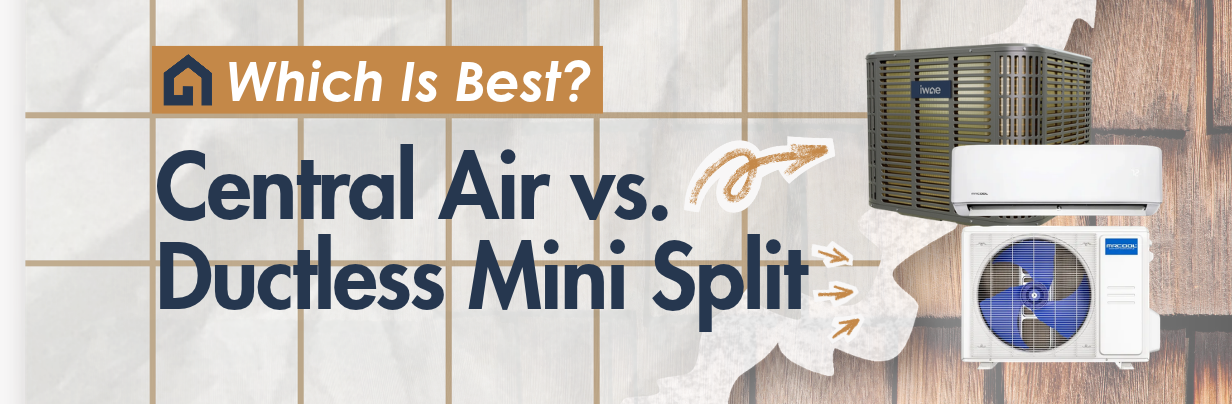
Central AC and ductless mini splits are the two most popular options for air conditioning systems for your home. While both serve the purpose of cooling, one may be more cost-efficient and energy-efficient than the other, depending on your needs and the size of your house or building. In this guide, we'll discuss the benefits of central air vs ductless mini split units to help you figure out which system is best for you.
What Is a Central AC Unit and How Does It Work?
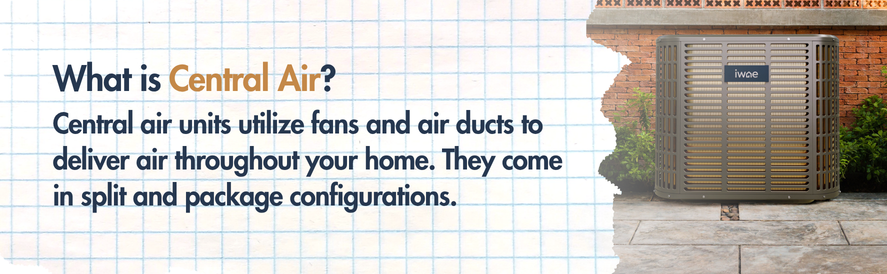
Central AC circulates air through your home via fans and air ducts. The central system is located outside of the house and cools the air down before moving it through the ductwork inside. Central air conditioning systems also dehumidify the air they bring into the home. If the region you live in is humid, removing moisture from the incoming air could be more difficult. It may be necessary to install a dehumidifier in the AC unit to ensure the system is not working too hard, which could cause your energy bill to spike and parts to require maintenance more often. The two main types of central AC units are split and package systems. We'll explain the differences below:
Split Systems
HVAC split systems are for homes with space for large indoor cabinets. In the split system model, the condenser and compressor are both located in an outdoor cabinet. The evaporator coil is the indoor cabinet, and the cool air is delivered to areas around the house via an air handler. A copper or aluminum tube — a line set that connects the outdoor and indoor components — moves cold air to the house.
Package Systems
If your home doesn't have a crawl space or basement, consider an HVAC packaged unit. Packaged HVAC units house all the system's components — including the condenser, compressor and evaporator coil — in a single metal cabinet to conserve space inside. Your HVAC installer places this cabinet on the ceiling or a cement slab outside of the house. Special ductwork joins the outdoor cabinet to all areas of the home. Although the cabinet is outdoors, you control the packaged central system's functions from inside. Packaged central air systems may also include electric heating coils or a natural gas furnace.
What Is a Ductless Mini Split and How Does It Work?
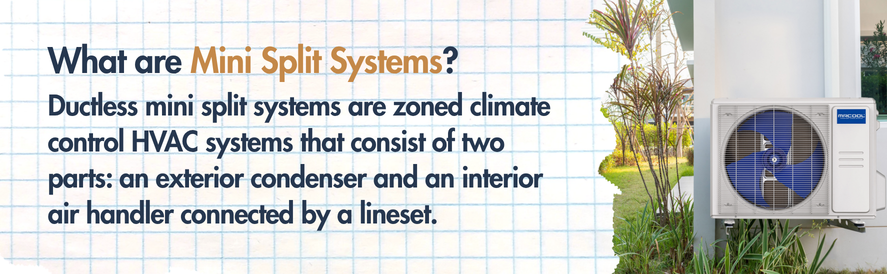
Ductless systems consist of two parts — an indoor evaporator unit and an outdoor compressor. Ductless systems are easy for professionals and some homeowners to install since they don't require any ductwork. These systems are common for apartments and small homes, and they are available in single-zone and multi-zone units. The indoor unit, typically mounted on a wall or suspended from the ceiling, directly delivers air into your living space. This indoor unit is connected to a compressor outside via a refrigerant line instead of a complex duct system. The indoor and outdoor units connect via section tubing, a condensate drain line and a power cable. In most ductless mini split systems, there are several indoor units connected to a single outdoor unit. You can independently control these multiple indoor units via remote control or thermostat, but they use a single outdoor heat pump to dispense or absorb heat. In systems with multiple units inside, each one is assigned to a specific room or zone of the house. Your HVAC professional will work with you to design zones to make your system as convenient and energy-efficient as possible. Your house's shape and size, as well as your desired level of cooling, will help you determine how many indoor units you need. For instance, you could place one indoor unit in your garage, on your first floor and upstairs. If you mostly stay on the first floor during the day, you can save money by keeping the other areas of the home at more energy-efficient temperatures. An HVAC professional can help you make the right decision for your home.
Which Costs More?
Specific costs vary depending on factors like the presence and quality of any existing ductwork and the size of the building you're cooling. Consider ongoing heating and cooling costs and the energy efficiency of the product you choose. A ductless system is great for new homes and additions to existing homes. They are also an excellent way to avoid having to replace old air ducts. If your house does have ductwork, the installation professional will seal your air registers, preventing pests from entering your home and keeping contaminants like dust from escaping and lowering your indoor air quality. Removing the old ductwork is not necessary in this case, which could help minimize costs. Alternatively, central air systems make sense in homes with existing ductwork in working or near-working condition when the cost to repair wouldn't be more than the cost to install the HVAC system.
Let’s do a deeper breakdown of the cost. Installation fees range greatly from state to state. Nationally, the average costs range between $3,500 and $18,000 for HVAC installation by a professional technician. Where you fall in this range will depend on the system you’re installing, how many zones you need to cover, and the complexity of the install. You’ll also need to consider the price of the installation itself. So, let’s use our imaginations for a bit. Say we’re looking to add an HVAC system to a small, new home that measures in around 1500 square feet total, with the need to heat and cool 3 bedrooms and a living room. A central split system could easily service this entire home. If you were to purchase mini splits, you would need to determine how many mini splits you’d need to service the whole home, or you would need to find a 4 zone mini split. With that in mind, let’s look at the price breakdown below. For this example, we’re highlighting one central split system, one homeowner install 4 zone mini split, one homeowner install single zone mini split, and two contractor grade single zone mini splits of varying efficiency ratings.
NOTE: Prices are subject to change. The prices reflected below are purely for demonstration.
|
IWAE TruInverter Heat Pump Mini Split With MrCool DIY Line Set (Single Zone) |
Contractor Grade IWAE TruInverter Heat Pump Mini Split(Single Zone) |
||||
|
Size |
2 Ton |
42K [4 12K Air Handlers] |
12K |
12K |
12K |
|
Efficiency Rating |
18 SEER2 |
21.8 SEER2 |
23 SEER2 |
23 SEER2 |
17 SEER2 |
|
Equipment Cost |
$3502.60 |
$6,524.00 |
$1275.00 x 4 |
$1373.36 x 4 |
$756.32 x 4 |
Notice: Even do-it-yourself mini split installations legally require the help of a licensed electrician. The total cost of installation will include the cost of electrical hookup.
Now that you’ve got a breakdown of the equipment costs, consider what your installation costs will be. For mini splits you can install yourself, like the MrCool DIY Multi Zone Mini Split 42k BTU 4 Zone, the only installation cost you’ll need to factor in is the cost of an electrician. For contractor grade equipment, you’ll have to pay for an HVAC technician to complete the install, which can easily double the overall cost.
Central Air vs Ductless Mini Split: Which is Better at Zoning?
Mini splits come in a variety of zoning sizes, ranging from single zones at the smallest and 6 zones at the largest, for now. They have a clear advantage when it comes to temperature zoning. Having a mini split unit in every air-conditioned room lets you control the temperature in each area more effectively. If there's a room you don't use regularly, you can turn off the mini split unit there to conserve energy. You can easily adjust the temperature in rooms that heat or cool quickly. This room-by-room control also means it may be easier to achieve lower energy costs than with a central AC system. However, you may not need such specific temperature regulation. Unless there’s a marked need for individual zoning, many homes make it by just fine with a single zone central split system. For homes with one or two rooms that need specific heating and cooling, the combination of central heating and cooling and a dedicated mini split works great.
Is a Ductless Mini Split or Central AC Easier to Install?
Ductless mini splits are far easier to install because they don't require ductwork — your HVAC installer will only need to drill a small hole through a wall to connect the indoor and outdoor units. Central AC systems require more complex installation in many homes, especially those with outdated ductwork. The amount of space needed for ductwork and central AC system installation also means that some homes will be too small for this HVAC method. Also consider that HVAC advances are relatively recent. Older homes were not built with AC and heating in mind, and therefore are more difficult to retrofit complex ducted AC into. In these cases, it is far simpler to install mini splits.
Are Mini Splits or Central Air Easier to Maintain?
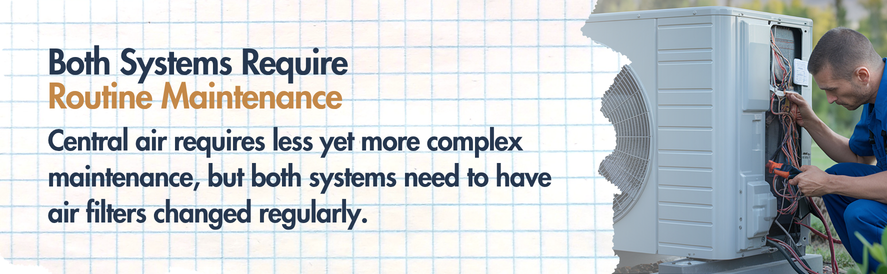
Both systems require routine maintenance, such as replacing filters and removing debris, but mini splits have the advantage of not having ducts that need to be regularly cleaned out. Ductless mini splits are also more compact and contain fewer parts, making lifelong maintenance much easier. Although maintenance for mini splits is more accessible, you must perform it more frequently. Experts advise washing filters regularly to keep unit fans debris-free. Clogged filters could impact air quality or make it harder for a mini split system to cool your home. Central air system maintenance is less frequent but more complex, as you must maintain the ductwork itself. If your central AC system isn't cleaned properly, dirt and bacteria can build up in the air ducts. Ducts are challenging to access on your own and should be maintained with a professional's help.
Do I Need a Mini Split or Central Air?
When deciding between a mini split or central air system, the most significant factor to consider is if you already have ductwork installed in your home. If so, sticking with a central system is more cost-effective if you're prepared to schedule preventive maintenance and regular duct inspections. If you don't have ductwork, installing a ductless system from scratch will cost considerably less. They are excellent for homes with new additions that are unconnected to existing ductwork running through other parts of the house or building. If you're still unsure which option is right for you, ask yourself the following:
1. How Large Is Your Home?
If you have a larger home, ductless systems are usually not recommended because they may not have sufficient power to cool all the air over so much square footage. In these situations, the power of a central air system will pay off and operate more efficiently. Smaller homes and apartments without ductwork will likely require a ductless system, especially if you're adding your HVAC into a structure you can't install new ductwork in, like a hotel or condo.
2. What Is Your Budget?
A single indoor ductless unit can be more expensive if you need multiple indoor units or opt for the highest energy-efficient model. Central air systems typically cost more than comparable ductless models, but some of the most energy-efficient ductless systems could cost more than low-efficiency central AC. It all comes down to your home, where you shop and your budget. While creating your HVAC budget, consider:
- How many rooms are in your home
- The size of your home
- The climate you live in and the average temperatures throughout the year
- Any insulation or windows that impact heating and cooling
- Existing ductwork placement and quality
- The energy-efficiency rating of the HVAC system in question
- Available resources for ongoing maintenance
3. How Important Is Energy Efficiency to You?
A central air system's energy efficiency depends on the quality of the installation and the ductwork. If your ductwork design has unnecessary turns and placements or lacks proper sealant, these things will decrease the central system's efficiency. When it comes to installation, the HVAC technician must ensure several things, including a level surface for the unit outside, the proper refrigerant level and other placement factors that impact efficiency. Ductless systems are often more energy-efficient, depending on the model and installation process.
4. Do You Want Zone Control?
If certain parts of your house tend to be much hotter than others — or people in your home prefer different temperatures — we recommend zoning systems. Both ductless and central systems offer zone control, but a central system may require ductwork modification with internal dampers, which adds to installation and maintenance costs.
5. Will You Mind Seeing or Hearing Your Unit?
When you're inside, you can't see a central AC system. Ductless systems require vents in the ceiling or slim units on your walls. Although manufacturers go to great lengths to make their ductless units as attractive as possible, they are nonetheless visible. If you're selective about décor, you may want to consider a central system. When it comes to sound, central air systems tend to be noisier than their ductless counterparts, but it depends on several external factors.
Can You Add a Ductless Mini Split to Central Air?
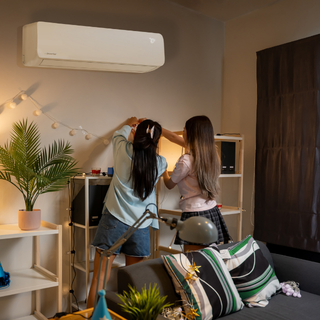
There are also situations where a homeowner already has a central air system and it makes sense to add a ductless unit because ductless units provide powerful comfort and run for a fraction of what it would cost to run central air. You can also integrate mini-splits into your home without serious retrofitting. If you're content with the central air system you have now but are interested in adding more temperature control to different rooms, consider adding a ductless mini-split. Here are situations where a ductless mini-split can make your life more comfortable:
- You'd like your own comfort zone: If you and your roommate or partner prefer different indoor temperatures and can't agree on what to set the thermostat, ductless mini splits give you room-by-room zoning comfort. You operate these units independently of your central AC system, allowing you to have a customized temperature in one area of your home without impacting your roommate or partner's comfort in another.
- You're adding on an addition: While you can extend your ductwork into the addition, the central air system you have was designed to cool and heat your home's specific size and layout. Increasing the home's square footage could negatively affect the HVAC system's performance. A ductless mini split doesn't require a connection to your ductwork, making installation quick and easy.
- Your upper floors are uncomfortably hot: Hot air rises, making the second or third floors of many homes hot, even when the AC is on full blast. While central air systems deliver the same volume of air to every area of the house, ductless units solve this issue by blowing concentrated cool air to the exact place it's needed.
Frequently Asked Questions About Central Air & Ductless Mini Splits
What's the difference between central air and a mini split?
A central air system is a whole home ducted system that delivers conditioned air. Central air systems can be split between indoor and outdoor components, or they can come in a packaged unit where all the components sit outside the home. Mini splits are ductless configurations that have visible indoor and outdoor components.
Is a mini split cheaper than central air?
This depends on what you buy. High efficiency mini splits can be more expensive than low efficiency central air units, but the mini split will help you save money on your energy bills over time. Cost is also determined by how complicated your installation would be.
Which is more efficient, central air or mini split?
Generally speaking, mini splits are more efficient than central air systems. However, this is only in relation to the size of the space you need to cool. Even efficient mini splits struggle to handle large homes. In these cases, central air is the better choice.
Can a mini split cool a whole house?
A single zone mini split cannot cool an entire home unless that home is small and lacks many divisions between rooms. If you have a multi-bedroom home, a multi zone mini split would be a better option. Remember though: mini splits are generally not good at conditioning large spaces. In many cases, central air is a simpler solution for whole home heating and cooling.
Shop Heating and Cooling Solutions From IWAE
Heating and cooling systems are essential to making your home comfortable, which is why we make it easy to select the best system for your needs. Whether you're looking for a ductless split system, central split system or package unit, IWAE has a wide selection for you to choose from. Shop our HVAC products today. Learn more about your home's heating and cooling options by visiting our resource learning center, which is full of helpful tips and tricks for understanding your HVAC.