
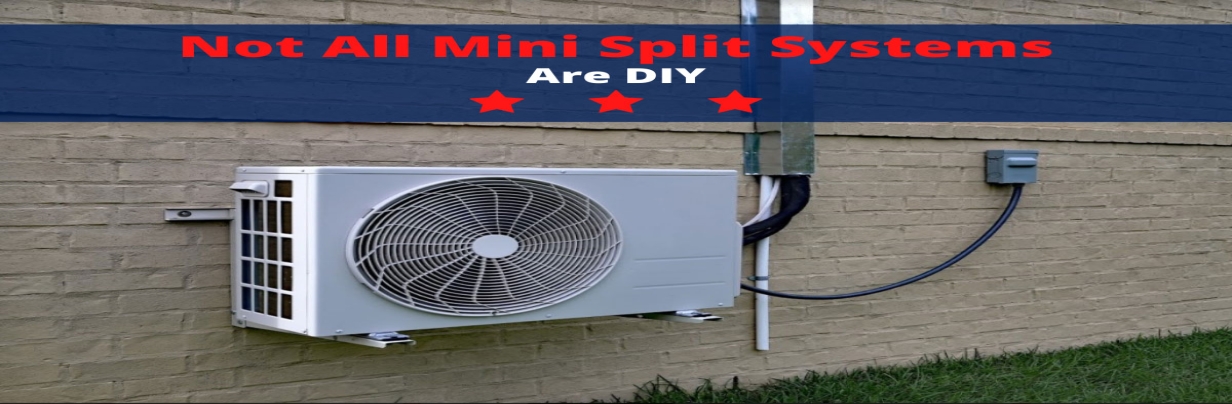

You've heard about ductless mini split systems and how easy they are to install. They're certainly great products, but that doesn't mean they're all DIY.
How can you tell the difference?

Mini Split Systems Are Not All Created Equal
We sell a lot of mini split systems. We get a lot of questions about them too. One thing that keeps coming up time and again is the assumption that all ductless mini split systems are DIY friendly. Now, it could be argued that they are easier to install than conventional HVAC. They're lighter and don't need ductwork. Plus, they can go just about anywhere.
However, most all ductless mini split systems do require a lot of the installation steps that unitary products do. A ductless mini split system has refrigerant lines. Those typically are flared and vacuumed to remove any contaminants. Ductless mini-splits use refrigerant. Once the system is installed and sealed, that refrigerant has to be at the correct level in order to ensure effective, long term performance. If it's not, or if there is an undetected leak, performance will be seriously impacted sooner rather than later.
So, Why Do People Think All Mini Split Systems Are DIY?
We blame the MRCOOL DIY. Unlike most ductless mini split systems, it is a legitimately DIY mini-split. The advantage comes thanks to the pre-charged and sealed "No-Vac" line sets. No charging or vacuuming is required.
Which is good, and we highly recommend the MRCOOL DIY.
However, it has led many people to believe that all mini split systems are do-it-yourself. That simply isn't true. So, if it's not the MRCOOL DIY, it is very likely a conventional mini split system best served by professional installation.
More Questions or Comments?
Do you want to know more about mini split systems or the MRCOOL DIY? Let us know here, on Facebook, or on Twitter.