
Key Points
- Air conditioners remove heat from inside your home to cool you down in hot weather. They do not heat on their own, making ACs a great solution for hot climates.
- Heat pumps can remove or supply heat to your home, offering year-round climate control. Heat pumps are ideal for regions with hot summers and mild winters.
- Always check local & state ordinances. Some states have mandates that require heat pump installations for new residential buildings.
Have you grown tired of tolerating subpar heating and cooling performance, but you’re not sure where to look for a better HVAC solution? IWAE is here to help you make it past the finish line. After all, many factors influence what the best solution is for your home. Climate zones affect HVAC performance and efficiency standards, so knowing the types of hardware allowed and minimum efficiency ratings required in your area should always be step #1 when choosing a new system. Once you’ve found the information you need about what all can be installed in your region, it’s time to answer the condenser question: heat pump or AC?
What is an Air Conditioner?
Air conditioners have been a staple for home climate control for around 60 years. How an AC works is fairly straightforward:
- The evaporator coil cools the hot air within your home
- The refrigerant flowing through the evaporator coil absorbs the heat and vaporizes
- The refrigerant vapor travels to the condenser, releasing the heat outside and liquefying
- The refrigerant liquid travels through the expansion valve back to the evaporator coil
Then the process repeats, both dehumidifying and cooling the air within your home. The US Department of Energy has a history of air conditioning that really puts the process in perspective. For instance, did you know the path to air conditioning began all the way back in the 1840s based on experiments from a century earlier? Even though we didn’t see more practical applications of the technology until the 1904 St. Louis World’s Fair, a development that was followed by the integration of AC systems in movie theaters during the 1920s, it’s tough to imagine such an important technology being such a recent development. Most of us have only known a life with reliable indoor heating and cooling performance. In the modern day, air conditioners come in a variety of shapes and sizes. The most common options include:
Air Conditioner Pros & Cons
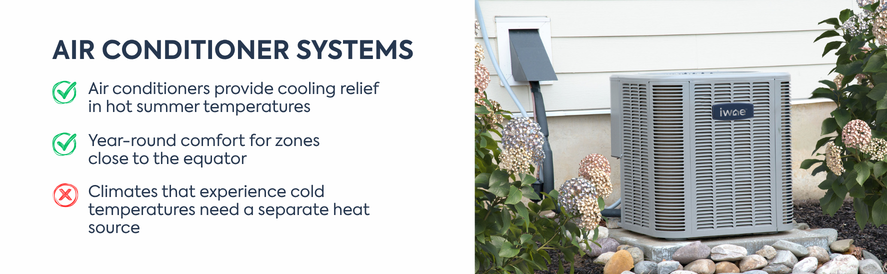
- Pro: Air conditioners provide relief in the hot temperatures of summer and year-round for areas close to the equator that stay toasty in every season.
- Pro: ACs are a more cost-effective solution for cooling in climates that don’t require dedicated heating.
- Con: For climates that vary by the season, ACs need a separate heat source added to provide warmth in winter. Options range from electric heat kits for moderately chilly temperatures to a dedicated indoor furnace to combat frigid outdoor conditions.
What is a Heat Pump?
Similar to air conditioners, heat pumps are a great way to beat the heat. Both systems use the same process to remove heat from your home, so you won’t notice a huge difference in results when it comes to cooling comfort. The real value of a heat pump is in its versatility. Where an AC only offers cooling, how a heat pump works differs by reversing the flow of refrigerant to pull heat from outside into your home. This means that winter temperatures don’t require a separate unit; instead, flip your heat pump to heating mode to keep cozy. An ideal solution for those who live in regions with mild winter weather, a heat pump will maintain toasty indoor temperatures with better efficiency than electric furnaces or electric baseboards. Heat pumps can even give some gas furnaces a run for their money in terms of cost per BTU!
The one area where a heat pump struggles is in regions with extreme cold weather. The lower the temperature of the air outside, the harder the heat pump has to work. In fact, a low enough temperature can cause the condenser to freeze entirely (spoiler alert: that’s a bad thing). With that being the case, many homeowners still choose heat pumps for heating part of the year until frigid conditions force a switch to gas or propane. Overall, using a heat pump in this way still results in significant savings comparatively. Heat pump condensers are found in:
Heat Pump Pros & Cons
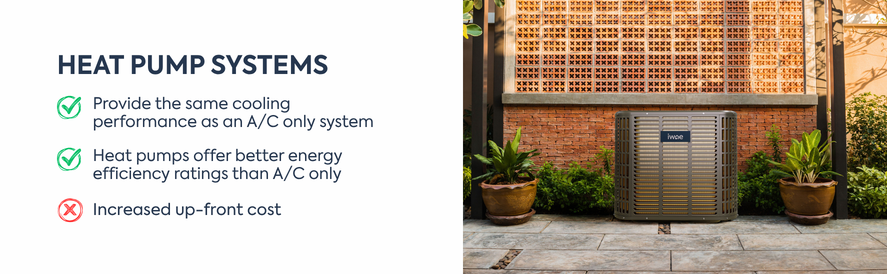
- Pro: Heat pumps provide the same cooling performance as an AC, while adding the ability to warm your home during the winter months.
- Pro: Generally speaking, heat pumps offer better efficiency ratings than air conditioners.
- Con: Heat pumps tend to struggle in extreme cold without a supplementary heat source, such as an electric heat kit or furnace.
- Con: Many heat pumps use a defrost cycle in the winter to protect the coils from ice buildup. While this fact is a pro in the sense that it ensures durability and longevity, the defrost cycle uses extra energy by pulling warmth from inside to heat the coils.
What Cooling Features Should I Look For?
Hunting for a system that supports the unique needs of your home doesn’t have to be a struggle if you know what factors to account for:
- Size: Ideally, you should have a licensed professional perform a Manual J calculation to verify the perfect tonnage or BTU system for your space. In our Window Unit vs. Mini Split post, we outline the basics of what BTU should be the starting point for a system’s sizing based on the square footage of the space the system will be supporting.
- Additional considerations that affect what size unit you need include: the region’s climate, the height of your ceilings, the number of residents, the number of large appliances installed in the space, your home’s insulation quality, and more.
- Installation: As of the writing of this article, all air conditioner options on the market require a licensed HVAC installer to handle the setup. Most heat pump systems share this standard, but not all! Ductless mini split heat pump systems like MrCool’s DIY series put the power of installation in your hands.
Size and installation requirements are two big aspects that may define the best path forward, but the additional features and inclusions offered by some of these systems may tip the scales:
- Convenience: Do you want to eliminate the need to get up and walk to the thermostat every time you need to adjust your settings? Many heat pumps have climate control customization that can be changed from the comfort of your couch. Find a system that comes with a remote controller or pairs with a smartphone app to guarantee comfort without disrupting your relaxation time.
- Pro tip: Systems from MrCool with the “Follow Me” feature don’t need you to lift a finger; just keep the remote nearby, and your indoor unit will handle the rest!
- Flexibility: Giving your family the unique temperatures they each want for their space is impossible with a central system, but ductless mini splits place an air handler in each room or zone. AC units are mostly part of central systems, meaning they’re built to maintain a single temperature for the whole house. Heat pump condensers dominate the ductless market, providing personalized comfort in each room.
Should I Get an Air Conditioner or a Heat Pump?
If you’re still on the fence about which type of condenser to get, your local government may have already made the decision for you. Some states, like Oregon, have enacted a mandate that new residential buildings require a heat pump. So if you’re getting a home built in a state that has a similar requirement, the choice changes from “what type of condenser” to “which heat pump best supports the needs of my home.” Even if you reside in an area that doesn’t already require a heat pump, it’s worth it to use any of the rebates and incentives available to get ahead of the potential legislation that may come to your region.
Do you live in a climate that stays toasty all year long? Homes that only need a steady supply of cool air are the perfect fit for an air conditioner. Heat pumps will always have the ability to heat, so installing one in an area that won’t benefit from that functionality is an unnecessary expense with no real benefit.
Beyond your hand being forced, heat pumps edge out ACs in terms of long-term savings. In our 2026 Energy Efficient HVAC Systems buying guide, the results are staggering: 4 of the 5 categories listed a heat pump system as the best option for efficiency. The better your system’s efficiency, the more you’ll save. In fact, the most efficient systems out there, geothermal units, are all heat pumps. The proof is everywhere you look: a heat pump is an investment that will pay for itself in savings over the years while giving you the climate control results you deserve.
Pro tip: Learn more about geothermal heat pumps and their unmatched efficiency with our direct comparison breakdown of ClimateMaster and GeoCool!
IWAE's Favorite Heat Pumps
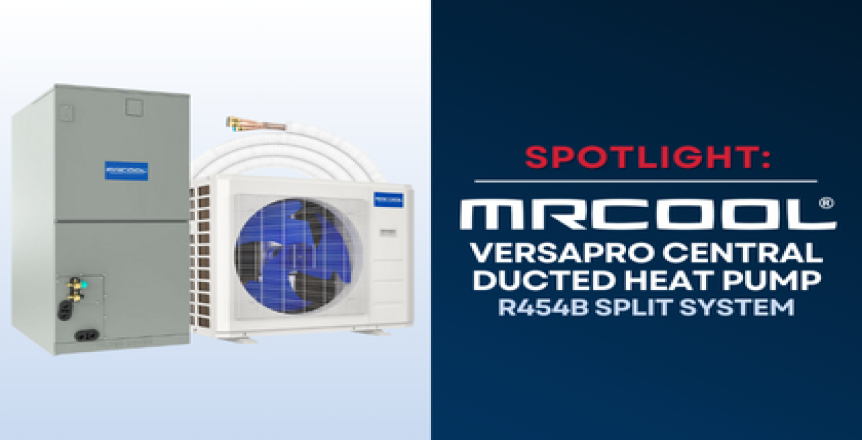
I’m sure it’s no shock that one of our favorites is the IWAE TruInverter heat pump split system, but the reason why may be more of a surprise! Heat pumps are only required to earn a SEER rating of 13 to 14, depending on the region where they’ll be installed. That makes our TruInverter series, with its SEER2 ratings ranging from 17 to 19, come in well above the curve in terms of energy efficiency for a central system.
For a ductless solution to handle single-zone heating and cooling, nothing comes close to the Mitsubishi FX ductless mini split systems. These incredibly efficient heat pumps give you access to a variety of features that tailor your results, while saving you money at every turn. The FX series from Mitsubishi is the perfect option for a single room that needs separate climate control capabilities, regardless of whether it’s integrated into your central HVAC system or not.
Maybe a package unit is more your speed. Luckily, MrCool has you covered with their Universal heat pump package units! Hovering around the 18 SEER2 mark, these systems give you all the climate control you want without needing you to support more than ductwork in your home.
Pro tip: For those needing a commercial-sized system, Daikin’s 5 to 10 ton package units can easily handle heating and cooling bigger spaces!
Stay Comfortable in Every Season with IWAE
Just because the standard for the past few decades has been an outdoor AC condenser and an indoor furnace doesn’t mean it’s the right solution for every homeowner. In fact, most residential buildings nowadays would benefit more from a heat pump than a dedicated air conditioner. With their high efficiency ratings and included heating performance, heat pumps are the future of indoor climate control for almost any region.
If you’re shouldering the full weight of your HVAC upgrade, let IWAE take the pressure off. Reach out to our customer service experts. They’ll learn the unique needs of your situation and help you find the perfect heat pump or air conditioner for your home.