
Key Points
- Geothermal heat pumps use underground loops to access consistent subterranean temperatures for efficient heating and cooling.
- You can use closed-loop or open-loop systems for geothermal heat pumps. Open-loop systems require a clean water source for safe operation.
- Geothermal heat pump systems require ample underground space for loops. Before you dig, verify there are no pipes, utility cables, or other obstructions.
- The upfront cost of geothermal systems is higher than air-source heat pumps, but their superior efficiency ratings result in better savings on utility bills.
- Geothermal heat pumps are sustainable, efficient, and quiet. Ground-source systems have a longer lifespan with less frequent maintenance needs on average.
American heating typically comes from three sources: Gas, oil, and coal furnaces. While these fossil fuels have served American homes well over the years, they are significant contributors to air pollution. These furnaces release CO₂ into the atmosphere, leading to major environmental consequences. Where do we turn if we want a cleaner, environmentally-friendly heat source? Geothermal heating technology is at the forefront of the push to find a better, more efficient way to stay comfortable in cold weather. This handy guide has all the facts about geothermal heating.
How Common is Geothermal Heating?
As of 2026, the U.S. Department of Energy reports that the United States is the largest global producer of geothermal energy, with the goal to produce 90 gigawatts of energy by 2050. As it stands now, the US has a geothermal electricity-generating capacity of approximately 4 gigawatts. Geothermal energy production in the form of electricity isn’t the same as geothermal heating. The power plants that utilize geothermal energy require much more complicated and intensive installations than anything you would put in your home, but they stand as proof that geothermal energy works. And it works everywhere. Geothermal heating systems can be installed in homes in every state, even Alaska. In total, the U.S. is host to over 1,000,000 ground-source heat pumps, with an additional 50,000 domestic geothermal installations going into the ground every year. Geothermal heating is all around us, and it’s here to stay.
What is Geothermal Heating?
Geothermal translates as "Earth’s heat." True geothermal heating involves drilling a well shaft many kilometers deep into the earth to tap into higher underground temperatures. The heat is then transferred to the surface. This method is predominantly used for large-scale applications, such as power stations, and is found mostly in the western part of the United States.
Similar vertical systems are also common for domestic properties, but do not descend nearly as far into the earth. Homeowners typically call in a well-drilling company, which uses a drilling rig to dig a 4-inch to 6-inch borehole to a depth of around 300 ft to 500 ft. These long vertical coils give the homeowner access to tap the warm, stable temperature deep underground. Vertical systems are also better if an aquifer is used to feed the coils. This system works by drawing the water up from the earth, passing it through a heat exchanger, and then returning the water to its source. It is super-efficient and has no negative impact on the planet, the atmosphere, or the aquifer.
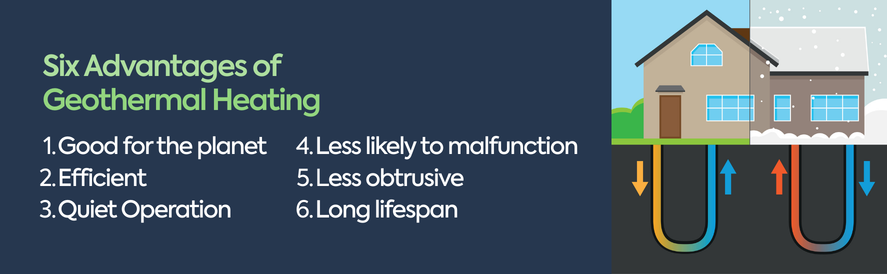
More commonly, geothermal heating on a domestic level typically involves laying a system of water-filled polyethylene ground pipes, horizontally in a loop, at least six feet below the surface of the ground (typically below the frost line). Because the earth absorbs heat from the sun’s rays, as well as rain, it stores this heat at a steady 45 to 75 degrees Fahrenheit. The liquid in the pipes increases in temperature as it warms in the soil, and, using heat pumps, this energy gets transferred into your home.
Types of Geothermal Heating Systems
Closed-Loop System
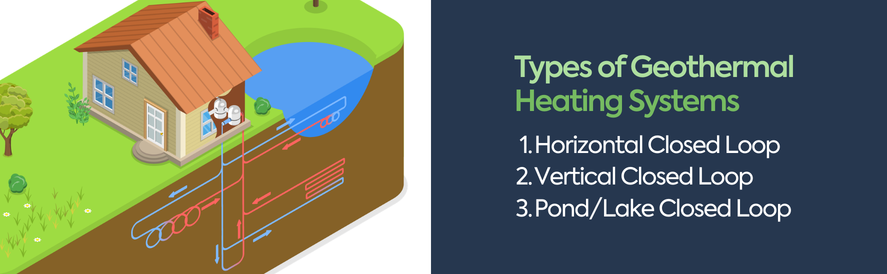
Typically, closed-loop systems circulate an antifreeze solution around polyethylene tubing, either submerged in water or buried in the soil. A heat exchanger then transfers the heat from the refrigerant in the heat pump and the solution in the coils. The advantage of this geothermal heating system is that it can be used in either vertical, horizontal, or pond and lake applications.
- Horizontal Closed Loop - This method is the most common and cost-effective system. Typically, two pipes are laid, either at differing depths or side by side, to a maximum depth of six feet. One cheaper way of arranging the coils is to use the Slinky method. This uses less space, allowing for geothermal installations in compact locations.
- Vertical Closed Loop - This is the method typically adopted by commercial businesses, public buildings, and schools. It also reduces the impact on the local environment. Either one shaft or multiple holes are dug, typically to a depth of between 100 ft and 500 ft, and roughly 20 ft apart. Pipes are inserted and connected at the bottom to form a U-bend, creating a loop, which is then connected to the heat pumps inside the building.
- Pond or Lake Closed Loop - If there is an open source of water nearby, a supply pipe is laid underground from the building to the water and coiled at least eight to ten feet below the surface. This is the cheapest way of creating geothermal heating.
Open-Loop System
Open-loop (also called a pump & dump) is an ideal option if you can tap into an underground water source, like a well. It is the most inexpensive option by far, but some local and county authorities don’t allow this type of installation, so be sure to check.
Geothermal Heating Requirements
Whether you opt for the vertical or horizontal loop system, geothermal heating is not going to be practical for everyone. If you live in a densely populated area, the chances of you having enough space to have a horizontal geothermal system installed are slim. You could opt for a vertical arrangement, which only requires a few square feet of land, but this will require specialized equipment. Before you do anything, though, remember that digging deep into the earth carries the risk of hitting buried pipes or utility cables. Be sure you coordinate with local utilities before anyone starts digging. By far, the most common option is the horizontal loop geothermal system. It also requires the most land. Let’s put this into perspective: 400 to 600 ft of pipework is required for each ton of energy needed. The average mid-sized home uses three times that amount of energy, so it would need 1,200 ft to 1,800 ft of coils. The upfront costs of retrofitting a geothermal setup into your existing HVAC are large, but a geothermal heating system is an excellent way to future-proof your home and reduce your reliance on increasingly expensive fuel costs.
Geothermal Heating Costs
A geothermal heating survey is the best and most accurate way to determine your requirements and the cost for installation in your space. Still, as a rule of thumb, the average 2,500 square feet home, with a heating and cooling load of 60,000 BTU (British Thermal Unit), can cost somewhere in the region of $20,000. That is definitely a premium price for heating and cooling. However, it's not the end of the story. Many states and utility companies offer their own geothermal incentives. Check your local programs. You might be able to get additional tax rebates, interest-free efficiency loans, or just flat cash back. And let us not forget about those lucrative long-term savings. Energy Star estimates that the savings on heating and cooling costs could be as high as $830 annually when compared to conventional HVAC products. Moreover, many homeowners see a 10 - 20% return on their investment over the lifespan of their system.
6 Advantages of Geothermal Heating
1. Good for the Planet
Switching to geothermal heating not only saves you money in the long term, but it also helps to reduce carbon emissions in the atmosphere. The Environmental Protection Agency rates geothermal heating as the most environmentally friendly, cost-effective, and energy-efficient heating technology available.
2. Efficient
Geothermal heating systems run super efficiently compared to traditional methods. A geothermal heating system can be as much as 500% more cost-effective. That means that for every $1 you spend to heat your home, it returns five times the efficiency.
When you compare geothermal heating to the most efficient gas furnaces, which have a rating of 98%, you get a clear idea of the advantages of going green.
3. Quiet Operation
Do you hate noisy air conditioner compressors? Install the geothermal operating components far from where they'll impact your peace of mind.
4. Less Likely to Malfunction
Your home and the Earth itself protect a geothermal heating system. Damaging wind and rain can't hurt a system it can't reach. And that means fewer long-term operating problems for you.
5. Less Obtrusive
A conventional condenser squats outside your home. With geothermal, there is nothing bulky or conspicuous on your property.
6. Longevity
Geothermal heating lasts, on average, ten years longer than a conventional system. If serviced well, geothermal heating systems should last up to 25 years. Premium systems from ClimateMaster geothermal heat pumps are engineered specifically for this kind of long-term reliability, ensuring your investment pays off for decades. Don’t just take our word for it, the Department of Energy agrees. And the coils buried in the ground should be good for 50 years plus!
Shop Geothermal Heating at IWAE
Geothermal heating is an increasing reality for many. Reducing our reliance on fossil fuels will no doubt be challenging. It will require complex solutions and participation across the spectrum of society. In the case of geothermal heating, the best news is that not only is it cleaner for the planet, it also saves you money month after month. And while the initial outlay is daunting, the potential return of a basic ground-source system can be very lucrative. In only a few years, you could see your geothermal heating savings make up for the extra installation cost. Then you'll start getting a real return on your geothermal heating investment. Given that geothermal heating is both better for the environment and our wallets, we should all be able to breathe a little easier. Check out our ultra-efficient geothermal selection today for a greener tomorrow.