

Key Points
- Geothermal heat pumps have a high entry cost, but offset those expenses with utility bill cuts. Many homeowners offset the initial price within three years of use.
- Geothermal system maintenance requires regular air filter replacement, clean and airtight ductwork, and an annual inspection from a professional.
In case you haven’t already heard the news, geothermal energy is the latest, greatest option for enjoying energy-efficient heating and cooling in your home. Many homeowners who install a geothermal heat pump save enough on their utility bills to offset the initial installation costs within 10 years, though some manage in just 3 years. That’s a return on investment that you can take to the bank! Factors ranging from the soil in your yard to the climate in your region affect how you benefit from a geothermal heat pump, but one facet that affects every HVAC system’s efficiency equally is routine maintenance. If you're considering making the switch to geothermal, or if you already pulled the trigger, it’s crucial to know how to keep up with your geothermal heat pump’s maintenance.
The Benefits of Geothermal Heat Pump Maintenance
It doesn’t matter whether you’ve rented your whole life or only lived in homes owned by you or your loved ones: the benefits of annual HVAC maintenance are easy to see. Regular cleaning and maintenance of your HVAC system saves you money by minimizing the frequency of more in-depth, costly repairs and keeping utility expenses low each month. For most of us, it only takes one full system upgrade caused by inadequate upkeep to understand how much annual servicing really saves.
Maintenance and repair costs are generally significantly less expensive than a full system replacement. For geothermal systems, this trend is exacerbated by their higher-than-average entry cost. The correlation is pretty straightforward: keeping your system in good shape with regular inspections lets you catch hardware failures before they cause additional system damage. A few hundred dollars today for a replacement valve or motor, or a few thousand dollars next year when your system fails to fight off a bad winter storm? HVAC problems can spread through a system like the plague, one broken part starting a chain reaction of additional complications. With regular maintenance, you can keep the dominoes from falling before the first one topples.

How to Effectively Maintain a Geothermal Heat Pump
Just like any other type of complex machinery, geothermal HVAC systems must be properly cared for to keep them running long-term. This maintenance work isn’t just for show: smooth heat pump operation maintains the lower utility bills that offset the high entry point of ground-source units.
Wondering what routine maintenance your geothermal system needs? Here are some geothermal maintenance tasks you should do regularly to ensure safe, efficient operation:
- Keep the air filter clean: Clean or replace your air filter quarterly. If you have pets or live in an area with harsh air conditions, you’ll need to change the filter more often. Changing the air filter is one of the most important things you can do to keep your system operating efficiently.
- Remove dust and debris: Keep the system and the area directly around your unit free of dust, dirt, and foreign objects. The air filter is the most obvious part to keep clean, but particles on the coils or fans also affect efficiency. If it looks dirty, give it a good clean.
- Check your ductwork & insulation: While they’re not technically part of the geothermal heat pump, they are part of your greater HVAC system. It’s important to verify there aren’t any breaks in your home's ducts or gaps around the doors and windows. Your ground-source system is only as efficient as your home can maintain, meaning leaks will tank your savings. If you can’t seal the leaks yourself, call in a professional.
- Schedule yearly maintenance: Get an annual system inspection from a trained professional. Don’t skip regular maintenance because your system is operating as expected– that missed check-up could be the difference between another year of top-tier performance and a total system failure.
Can You Do Geothermal Heat Pump Maintenance By Yourself?
Sometimes it’s difficult to determine what’s within the scope of doable DIY maintenance and what needs to be handled by a professional. Never fear, IWAE is here with a quick, easy list to explain what you are qualified to handle and which tasks are well above your pay grade.
|
You (the homeowner) |
Licensed HVAC Technician |
|
|
Air filter replacement |
✅ |
✅ |
|
Removing dust & debris |
✅ |
✅ |
|
Inspecting ductwork |
✅ |
✅ |
|
Cleaning components |
✅ |
✅ |
|
Visual inspection |
✅ |
✅ |
|
Testing normal operation |
❌ |
✅ |
|
Refilling refrigerant/antifreeze |
❌ |
✅ |
|
Installing replacement parts |
❌ |
✅ |
At the end of the day, anything you can do for your geothermal system, an HVAC technician can do better. But that shouldn’t stop you from giving it your all! Yearly maintenance is essential to keep the hardware operational and efficient. Just because you’ve never given much thought to these tasks before doesn’t mean it’s too late to start! Although if you wait too long to give your heat pump the TLC it needs, you may wind up with damage in your system.
When to Replace Geothermal Heat Pump Parts
Curious about what parts go into making shockingly efficient geothermal heat pump systems? Our Geothermal Heat Pump Buying Guide gives a full breakdown of what each part does, but the core of your geothermal system is the pump, ground looping, and air delivery. Many ground-source systems also include helpful, efficient additions like an auxiliary electric heater or a desuperheater. While any of these components can fail as a whole, the likelihood of an occurrence that catastrophic isn’t likely when you keep up with yearly cleaning and maintenance tasks.
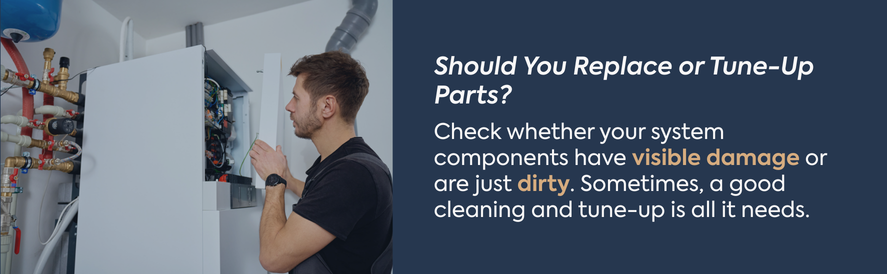
If part of your geothermal heat pump isn’t operating as expected, your climate control results and overall energy efficiency will suffer. Once you’ve invested in a geothermal system, there’s no reason to tolerate anything less than the best. Have a professional take a look so they can identify the problem. Sometimes, the system will just need some cleaning or a slight tune-up, but if your technician finds hardware damage, you’ll have to look for replacement geothermal parts.
Want to Know More About Geothermal Heat Pump Maintenance?
Annual maintenance shouldn’t be optional for your HVAC system, especially when you’ve made the long-term investment of choosing a ground-source heating and cooling system. From guides to guesstimates, IWAE has your back and your front with geothermal maintenance. Unsure whether your geothermal heat pump needs maintenance or a full replacement? Check out our 10-question-before-you-buy guide. Not sure why your unit is making a noise? Reach out to our team directly. The customer service experts at IWAE have the answers you need to the questions you didn’t even know to ask.